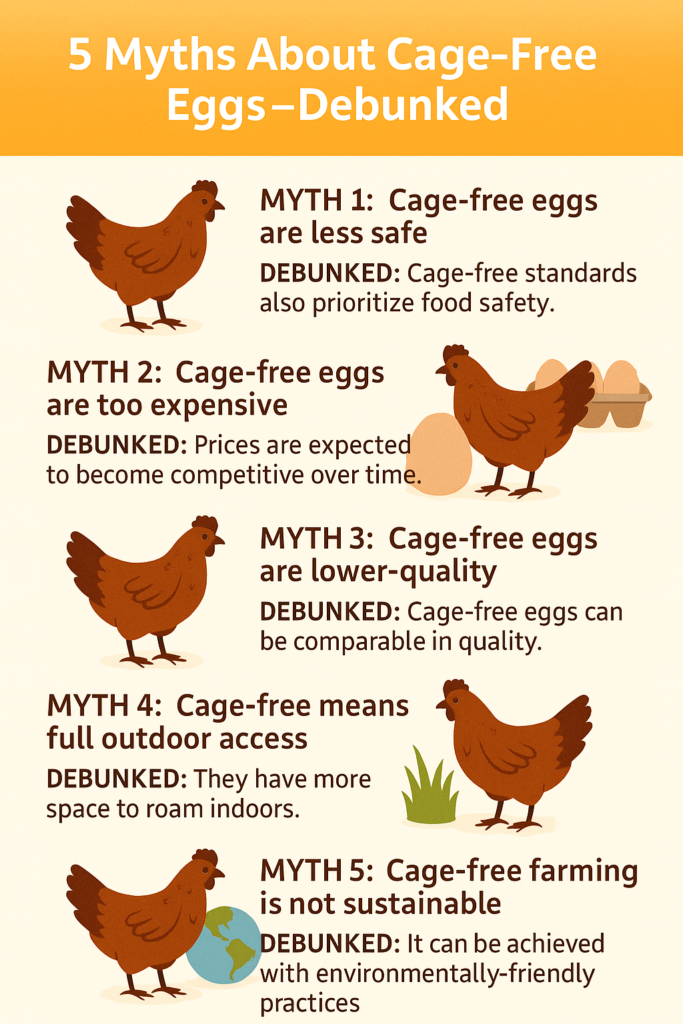
Cage-free eggs are showing up in more grocery stores, restaurants, and corporate sourcing policies around the world. But with increased visibility comes confusion—and misinformation.
Do cage-free hens really live outside? Are cage-free systems always humane? Is it all just marketing hype?
Let’s break down five of the most common myths about cage-free eggs—and uncover the facts behind the label.
Myth 1: “Cage-Free” Means the Hens Live Outdoors
Reality:
Cage-free hens live inside barns, not outdoors. The term simply means the birds are not confined to cages. Instead, they can roam within an open indoor space and engage in natural behaviors like:
- Walking and wing-flapping
- Perching and nesting
- Dust-bathing and foraging (if litter is provided)
Cage-free doesn’t guarantee outdoor access—terms like “free-range” or “pasture-raised” do. But even indoors, the ability to move freely is a huge improvement over battery cages.
Myth 2: Cage-Free Systems Are Just as Bad as Cages
Reality:
No system is perfect—but cage-free is significantly better for hen welfare than battery cages. In cages, hens are:
- Unable to walk or stretch their wings
- Denied access to nests, perches, or enrichment
- Forced to live in extreme confinement for their entire lives
In well-managed cage-free systems, hens can express key natural behaviors, which are essential to their physical and psychological wellbeing.
Myth 3: Cage-Free Eggs Are Too Expensive to Be Worth It
Reality:
While cage-free eggs can cost slightly more, the price difference is shrinking as more producers and retailers shift. And when you consider the true cost of caged systems—animal suffering, public health risks, and reputational damage—the investment in cage-free is worth it.
For companies, going cage-free is a long-term risk management strategy and a way to align with ethical values and consumer expectations.
Myth 4: Cage-Free Is Just a Marketing Gimmick
Reality:
Cage-free isn’t a meaningless buzzword—it’s a measurable change in housing and animal welfare practices. In fact:
- Major companies track cage-free sourcing across regions
- Auditing bodies and certification programs verify compliance
- Advocacy groups hold companies accountable for progress
That said, not all cage-free claims are created equal. Transparency, verification, and clear timelines are essential.
Myth 5: Cage-Free Doesn’t Work in Asia
Reality:
Cage-free production is growing across Asia, with success stories in the Philippines, Indonesia, Thailand, and beyond. Local producers, food brands, and governments are embracing the shift—driven by consumer demand and global supply chain pressure.
While challenges like infrastructure and cost exist, they can be addressed through:
- Support from technical partners like Global Food Partners
- Short-term use of cage-free credits
- Strong public commitments from leading brands
Cage-free is not just a Western idea—it’s a global movement with growing momentum in Asia.
Final Thoughts
Cage-free eggs aren’t perfect—but they’re a crucial step toward a more humane food system. By understanding the facts and challenging misconceptions, we can make more informed choices—and push companies to do better.
The more you know, the more you can do. 🐔